NEWER LICENSEES REFLECT ON THEIR STRUGGLES, GOALS, AND RECENT CONTROVERSIES
Interviews with more than two dozen newly licensed operators reveal a cohort sharply divided on recent political conflict, yet remarkably unified in its long-term ambition...
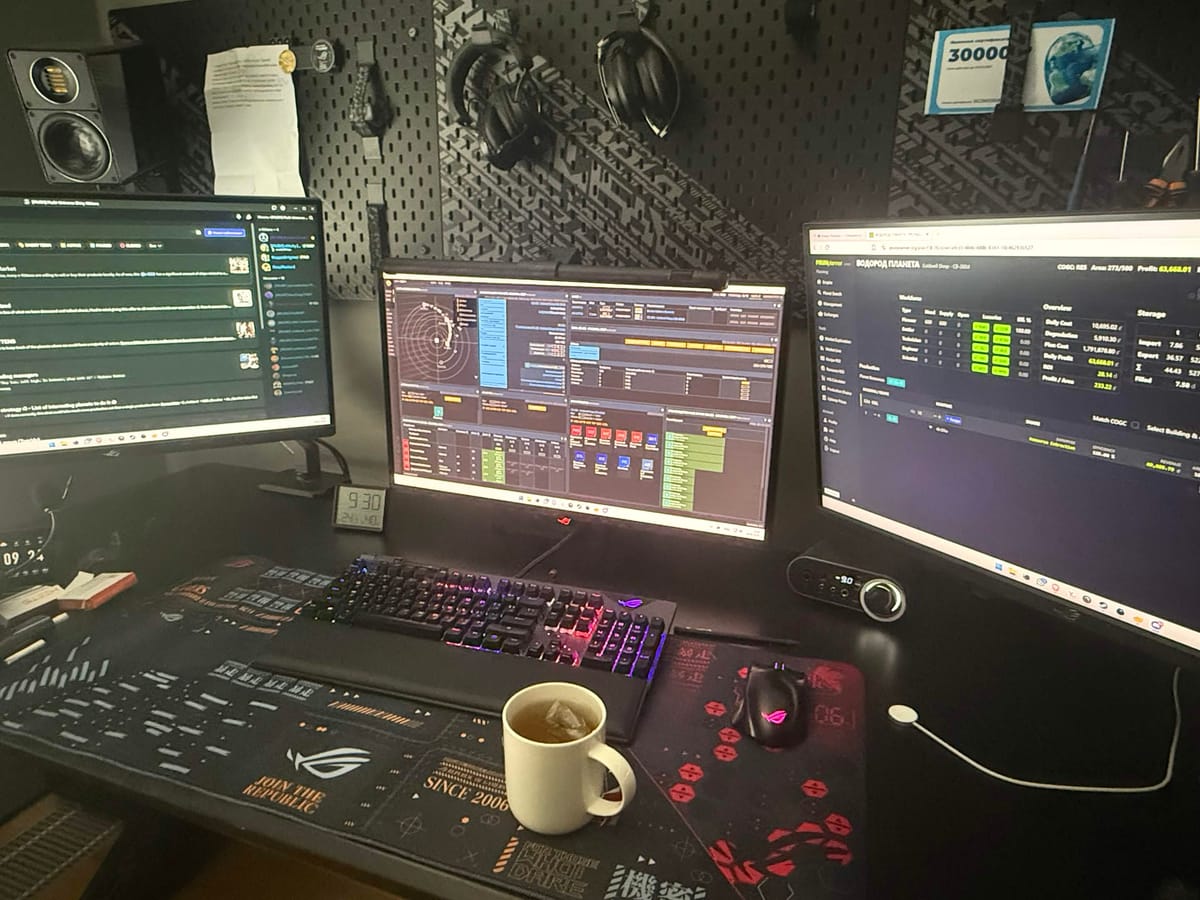
By [MUSK] Testerman55778 | Guest Correspondent
As the dust continues to settle around the Promitor election controversy and the sanctions debates that followed, much of the commentary in this publication and elsewhere has gravitated toward the senior corporate offices most directly involved.
Less audible, has been the cohort of licensees who have held their APEX credentials for fewer than ninety days—licensees whose first impressions of interstellar commerce have been formed against the backdrop of sanctions discourse, election irregularities, and the institutional question of how the polity ought to respond.
ICR canvassed more than two dozen newer licensees, drawn from across a wide range of corporations and unaffiliated operators.
The responses suggest a cohort that is broadly enthusiastic about the interstellar economy it has entered, while being sharply divided on the recent political turbulence, and—perhaps surprisingly, for so junior a group—already drafting long-range plans of considerable ambition.
Settling In: Depth, Pace, and the Price of Entry
If there is a consensus among newer licensees, it is that the universe they have entered is unusually deep.
CEO Knottly of Knott Interplanetary (KNIN)—having last accessed his APEX terminal some five years prior—returned to find himself “very impressed with the depth of mechanics and things to consider that are not swept up and ignored.” He singled out, in particular, the logistical complexity imposed by orbital dynamics, noting that shipping routes themselves fluctuate as planetary positions change.
The pace, too, attracts approving notice. For Wassah, a member of Supernova Foundries (SNF), it reads as an invitation to relationship-building, with Wassah describing “the slow pace of building relationships and cooperation” as “motivating.” Yuppie00 of Noploniad Enterprises (NOPE) framed the matter differently:
“I find it handy to have a venture where there’s only so much I can do in a day, rather than an endlessly tempting time sink.”
Not every voice in the cohort is satisfied with the opening hours, however. Lyhroi of the Cosmocene Combine (COSM) put it bluntly.
“It’s a slow start. WAY too slow.”
Mingrody with Multi-Universe Shiny Kittens (MUSK), by contrast, treated the learning curve as the price of admission, arguing that it was “steep,” but also “sort of a requirement for a deep and good activity.”
A second source of friction concerns the cost of APEX licensing itself.
KeepMustard, also of MUSK, indicated that he had not anticipated a monthly licensing fee when initiating his account and suggested he might revisit his participation depending on how things play out. CEO lotol (LTA) summarized the concern succinctly:
“[It] seems a bit of a ‘pay to advance’ deal…”
What appears to compensate for these frictions, in the cohort’s account, is the texture of the community itself.
Lyhroi (LYTE)—having registered the criticisms above—described the community as “the most non-toxic…that I’ve encountered in anything…for the past years,” while DZedd, affiliated with the recently formed Organization of Fuel Exporting Companies (OFEC) argued that without the community “drama,” the universe would risk becoming little more than a static exercise in logistics and production.
Motivations: Three Currents
The cohort’s motivations, in aggregate, sort into three broad currents, with substantial overlap among them.
The first is most direct—profit, viewed in roughly the same affective register a rising stock chart might invite.
Echoing the sentiments of the majority, Leafage of COSM described himself as “passionate about increasing profits, because I love watching the upward curve of my asset values, and…[expanding] further.” Papercamera7709 (JCJ) was more cautious, noting that he watched his profit-to-cost ratio carefully against the risk of a compounding setback.
The second current is the pleasure of optimization—the universe approached as a puzzle to be solved.
Knottly described himself as “very motivated by feeling like I was able to solve a puzzle, or create a unique and clever way to do something that gives me some advantage.” Other APEX licensees agreed that strategic planning within the constraints of the market was a major component of their satisfaction.
The third current runs through the cohort’s interviews more diffusely, and concerns the satisfaction of building infrastructure that endures—and of building it alongside others. DZedd was perhaps the most explicit on this score.
“My main motivation is building something meaningful here that actually changes something for someone, and working with other people on said things.”
PhantomSpace—a member of Ooga Booga Capital Management (OOG)—when asked what motivated him, listed “the mix of community building, faction politics, market competition, and occasionally catching some really profitable supply/demand swings.”
Other licensees added a note of generosity, hoping to one day help others as they themselves had.
After Promitor: A Cohort Divided
The political turbulence of recent weeks has produced the cohort’s most striking internal divisions.
Among newer licensees, the question of whether the recent sanctions debates and election irregularities are a feature of the universe—or an aberration within it—admits of no consensus.
One position represented at some length treats conflict as a structural good, with Jorropo of Lunar Mining and Operations (LMAO) arguing that “conflicts are like hot pepper in a Korean dish; sure it feels like your mouth is on fire, but if it weren’t there it would be bland and boring.” Memes_Of_Production (MO) adopted a more detached stance, commenting that such conflict is “pretty fun to watch from the sidelines with popcorn.” The licensees interviewed broadly agreed that conflict and controversy between major actors is an inevitable part of politics.
The second and more substantive position is the institutional critique.
A number of newer licensees signaled support for the principle of political consequence in the universe but argued that the present mechanisms are inadequate.
Papercamera7709 provided the cohort’s most detailed analysis, observing that “Raising the price of supplies someone relies upon only works until they change production lines, or diversify,” noting that such action “breaks down when there are more than a few people targeted, while also damaging the economy in the long term.”
His conclusion was unambiguous.
“If the APEX Regulatory Commission wishes to allow for conflict, then there needs to be methods for the community to actually discourage it.”
The third position foregrounds what the recent unrest has cost newer licensees specifically.
Lyhroi, surveying the controversy’s effects noted that “the recent activities did—from my point of view—NOT grow this prosperous universe, but put it at risk of decline,” concluding “it hurt the wrong people—the new licensees.”
The fourth position prefers cooperation outright.
Leafage reported feeling “quite exhausted” by “these massive clashes” and “strongly prefer[red] cooperation and market stability.” Some sought a middle path, exemplified by Paper-Accept (PAA) who stated “I wouldn’t want [conflict] removed entirely—rivalry is part of the fun—but I’d love to see more incentives for cooperative stability, like shared mega-projects or galaxy-wide economic events that reward teamwork.”
Worth noting, however, is how unfamiliar the controversy itself remained to a meaningful share of the cohort, with many reporting they had been unaware of the situation entirely. Yuppie00 noted that he had followed events through unofficial channels but that he "hadn't really understood what was going on.”
Plans Among the Stars: Long-Range Ambitions
For all the disagreement over conflict, the cohort is in broad consensus on at least one thing: it is already thinking on long horizons. Newer licensees described long-range plans that organize themselves into four loose categories—of which the first and most common is vertical integration.
drShots (DMTS) said his long-term aim was to “increase the vertical integration of my company to reduce reliance on outside vendors.” Several others cited vertical integration as a stepping stone to their final goal of shipbuilding, with Magicangel (GNMC) summarizing “I eventually want to be producing ships.”
The second is mega-project ambition—projects whose scale presupposes coordination across many bases or many licensees.
Leafage aspires to “complete a large-scale project and operate a massive transportation network—both of which would be incredibly cool things to do.” Knottly, marrying his science-fiction sensibility to that ambition, allowed that he “generally very much likes the part…involving mega-construction,” while PhantomSpace said he hoped “...[to] expand my fleet, support newer licensees, and hopefully take part in larger shipyard, stargate, and planetary development projects.”
A third group has its eye on the frontier—on planets and regions still being developed, and on the prospect of operating from outside the established corridors of trade.
Paper-Accept described the most evocative such vision.
“A neutral trade hub—a kind of ‘Switzerland’ of space—where factions can meet, trade, and negotiate without constant fear of blockades or sanctions.”
His ideal, he wrote, would be “economically powerful enough to be influential, but politically neutral enough to stay out of major wars.” Akyuu (TET), whose corporation’s full name signals its program, said his “ultimate goal is to move my company headquarters to the southernmost planet and develop it.” The Hubur region emerged repeatedly as a focal point for newer licensees interested in frontier expansion.
A fourth and smaller group is interested in influence on terms other than the balance sheet.
Papercamera7709 framed his answer carefully, conceding that competing on raw capital with the senior corporations may be impractical, and proposing an alternative metric to “see what sort of influence I could get over the economy by setting up supply chains” to produce “middle goods,” using those supply chains to “undercut other producers so that I become the main one instead of focusing on making a profit.”
The Cohort and the Universe Ahead
What emerges from these conversations is a cohort more cohesive than the surface noise might suggest.
Newer licensees disagree, sometimes sharply, on the proper place of conflict in the universe—but few describe themselves as disengaged from it, and fewer still as discouraged. Even the most exhausted respondents continue to plan, while the most stability-inclined describe ambitions on the scale of regional development, shipyard ownership, or neutral trade infrastructure.
For Paper-Accept, the long-range hope is for “a thriving, stable empire that helps keep the galaxy connected rather than divided.”
Whether the newly licensed will eventually find themselves as part of such a universe—or of a more contested one—is a question the cohort itself will answer in time.
[MUSK] Testerman55778, Guest Correspondent
C-05 Civil & Social Affairs | Benten Regional Dispatch
Interstellar Commerce Review